 Spend by Product Exec
Agents do the legwork. People make the call.
Each agent works one job end to end: it looks things up, makes internal and reversible changes, and proposes anything that moves money, leaves the agency or binds it to the person who holds that duty.
One place for everything the agents did
The Agents page shows what is waiting on you, a live feed of every run with its steps, and each agent's numbers: how much it handles straight through and how often people accept its proposals as written.
- Approve, edit or reject each proposal; your edits teach the next run.
- Set the mode per agent: automatic, on demand, rules only, or off.
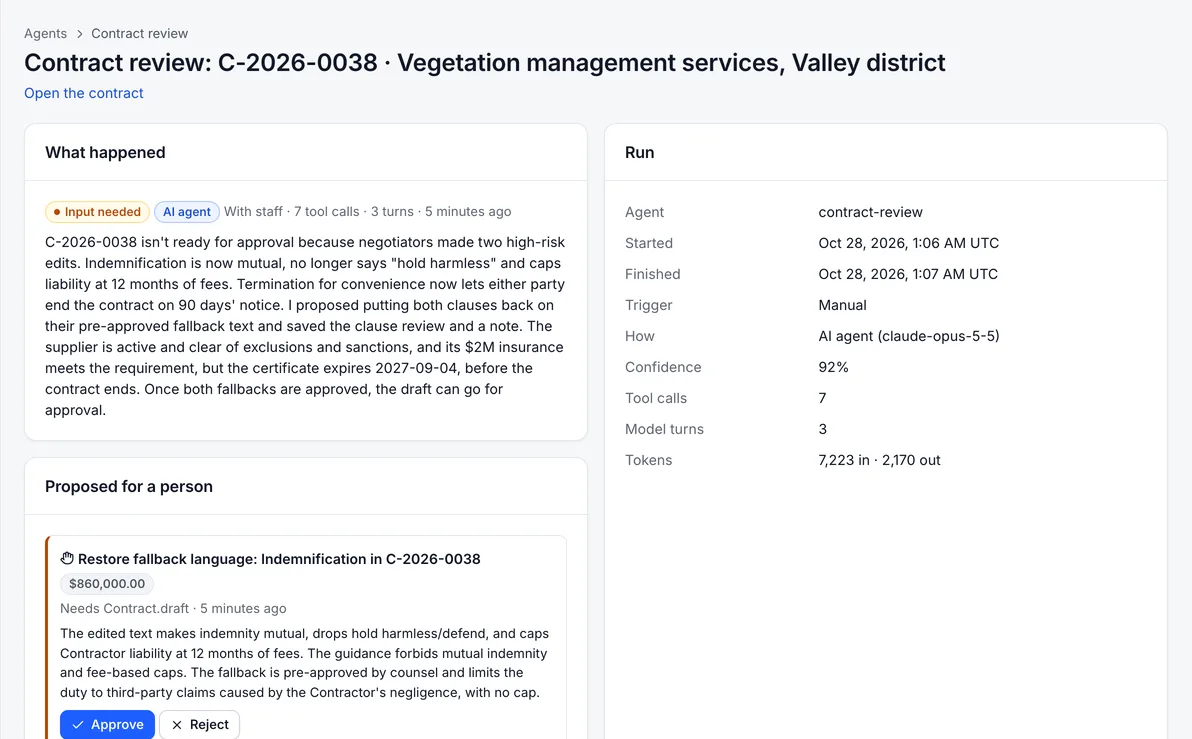
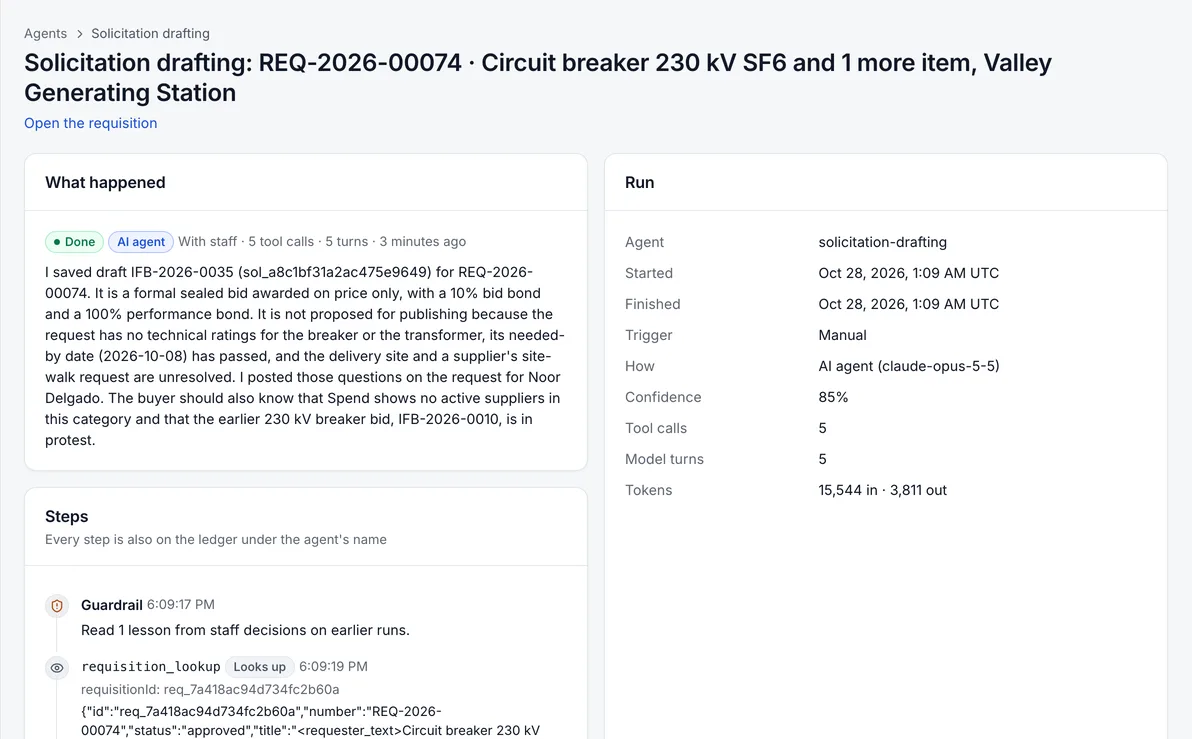
- Open any run to see each tool call, guardrail and proposal.
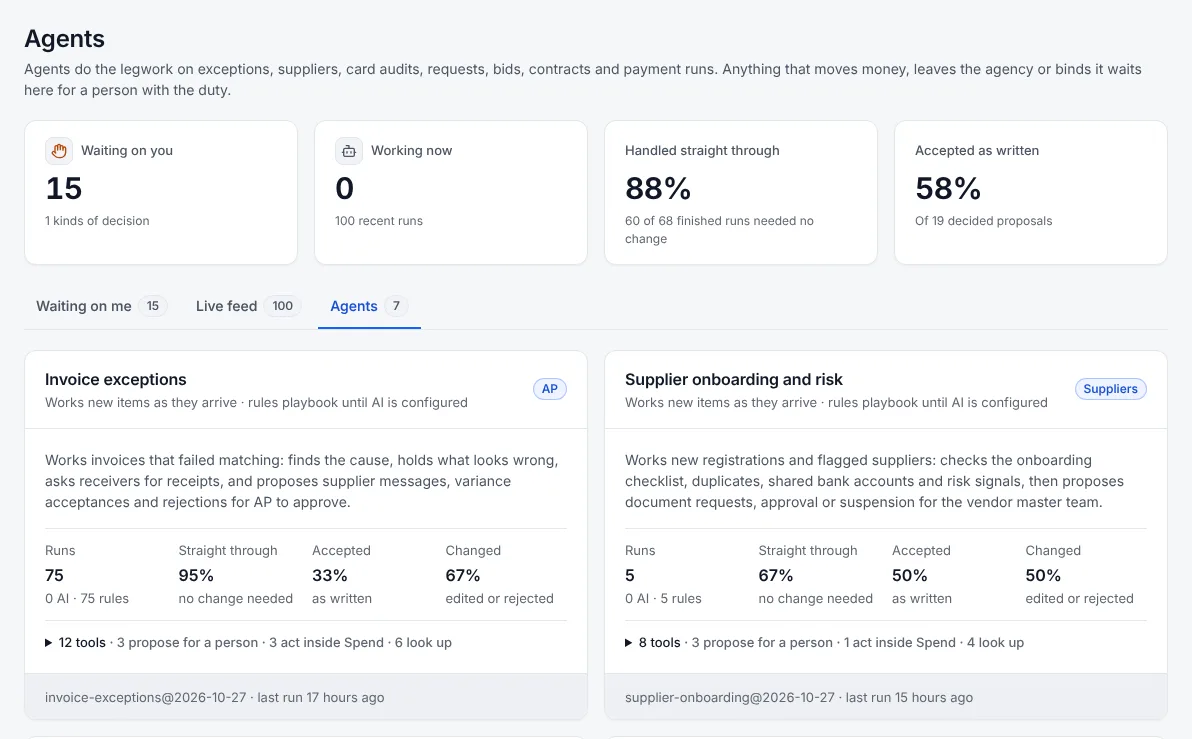
Seven agents, one per job
Invoice exceptions
Works invoices that failed matching: finds the cause, holds what looks wrong, asks receivers for receipts, and proposes supplier messages, variance acceptances and rejections for AP to approve.
Accounts payable AP staff decide
Supplier onboarding and risk
Works new registrations and flagged suppliers: checks the onboarding checklist, duplicates, shared bank accounts and risk signals, then proposes document requests, approval or suspension for the vendor master team.
Suppliers Vendor master team decide
P-Card review
Audits sampled card charges against the receipt, purpose, coding and policy; asks cardholders for what is missing and proposes the audit result and any suspension for the program coordinator.
P-Card P-Card coordinator decide
Request to PO
Takes approved requests that can be ordered directly: finds the contract, catalog price or supplier, checks the supplier can be paid, and proposes the purchase order for a buyer to issue.
Purchasing Buyers decide
Solicitation drafting
Turns a request approved for competition into a draft solicitation, checks the method and specifications, and lists what the buyer must settle before it is published.
Sourcing Buyers decide
Contract review
Reviews draft contracts against the clause library and policy: flags weakened or missing clauses, proposes restoring standard or fallback language, and proposes submitting clean drafts for approval.
Contracts Contract office decide
Payment run guard
Checks payment runs before release for duplicates, bank changes, shared accounts, barred suppliers and unusual amounts; proposes holding a payment for treasury to decide.
Treasury Treasury decide
How every agent is built
Read, write or propose
Each tool an agent has is a look-up, an internal and reversible change, or a proposal. Anything that moves money, leaves the agency or binds it is a proposal that waits for a person who holds that permission.
Never the decision
Agents can never approve, award, release a payment or change policy. That is enforced in the permission model, not in a prompt.
Every step on the ledger
Each tool call, guardrail and proposal is recorded with the model, prompt version and input digest, so an auditor can replay why something happened.
A rules playbook underneath
If AI is off, the model is unavailable, or the document is in a class kept from the AI provider, the same agent runs its rules playbook with the same tools.
Learns from your edits
When staff change or reject a proposal, the lesson is kept and applied to the next run for the same supplier or subject.
Measured
Each agent shows its straight-through rate and how often people accept its proposals as written, and is checked by an evaluation suite on every change.
Every step is visible
Copilot, Claude or your own, through MCP
Your agencies' own agents connect to Spend's Model Context Protocol server. Each acts for one person, with the tools, autonomy and amount limit an administrator sets, and can only do what that person may do.
Autonomy levels
- Read only: search suppliers, invoices, requests, contracts and the catalog.
- Draft: turn a description into a draft request for the person to check.
- Act: submit a request or hold an invoice, within the amount limit.
Approvals, awards, payments and policy changes are never available to an agent.
See it on your own invoices
We run a bake-off on a sample of your real invoices and connect to a sandbox of your ERP, so you can judge the results before you sign anything.