 Spend by Product Exec
Configured for each agency, not customized.
Spend runs every agency on the same code. What differs between a utility and a city is data: its policy pack, its org chart, its connectors and its keys.
Source to pay, on one record
- Step 1
Need
Someone asks in plain words on the web, by email or in Teams, or Maximo sends a work-order requisition.
- Step 2
Method
The policy pack picks the procurement method and approval chain; the budget is checked and pre-encumbered.
- Step 3
Source
Order from a contract or catalog, or run a quote, bid or RFP with sealed bids and a public opening.
- Step 4
Contract
Build the contract from the clause library; track obligations, insurance and price escalation.
- Step 5
Order and receive
Issue the PO, get the supplier's acknowledgment and record the receipt.
- Step 6
Invoice
Capture, match, code, tax-check and approve the invoice, or the pay application.
- Step 7
Pay
Prepare, approve, guard and release the payment run; post to the ERP and file the record.
What every product stands on
One ledger
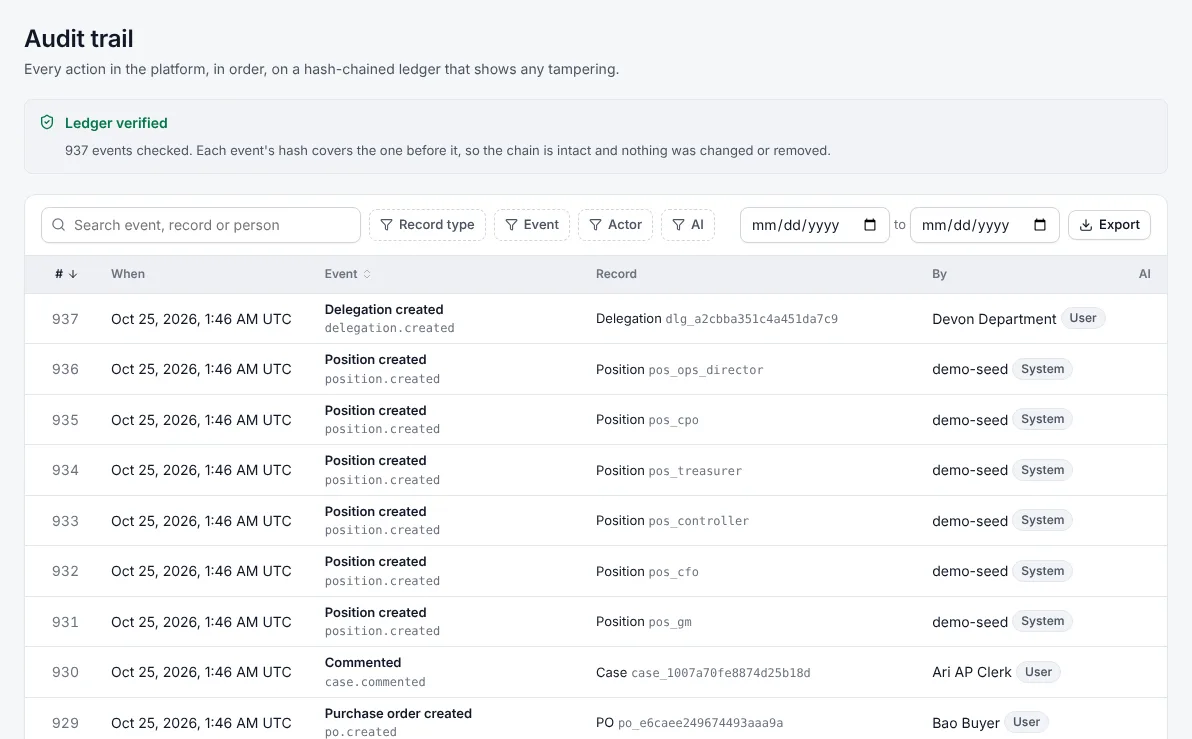
Every action by a person, agent, supplier or integration is appended to a per-tenant, hash-chained ledger with the actor and the duty performed. For AI output it also keeps the model, prompt version and input digest.
Policy packs
Procurement methods and thresholds, approval chains, P-Card rules, match tolerances, required clauses, retention and agent modes are data in a versioned policy pack. Changes are diffed and approved by a second person.
Roles and duties
Role-based permissions with segregation of duties checked when roles are assigned and again on every transaction, against the history in the ledger.
AI with evidence
Claude reads documents and runs the agents with structured outputs and quoted evidence. A rules engine does the same jobs when AI is off or a document is kept from the model.
Connectors
One ERP sync engine for Workday, Oracle EBS, Oracle Fusion and SAP, plus Maximo, CMIS archives, banks and networks, each with sync runs, a dead-letter queue and health.
Sealed storage
Records in Postgres and documents in S3-compatible storage, each encrypted with the tenant's own key before it is written.
A home for each person's work
My work shows each person what is waiting on them. Lists page, sort, search and filter on the server, and their state lives in the URL, so any view can be bookmarked or shared. Press ⌘K anywhere to find a record or jump to a page.
- Approve from a phone with the facts, lines and the original document, signed in with a passkey.
- Approve from Teams or Outlook with approval cards and actionable messages.
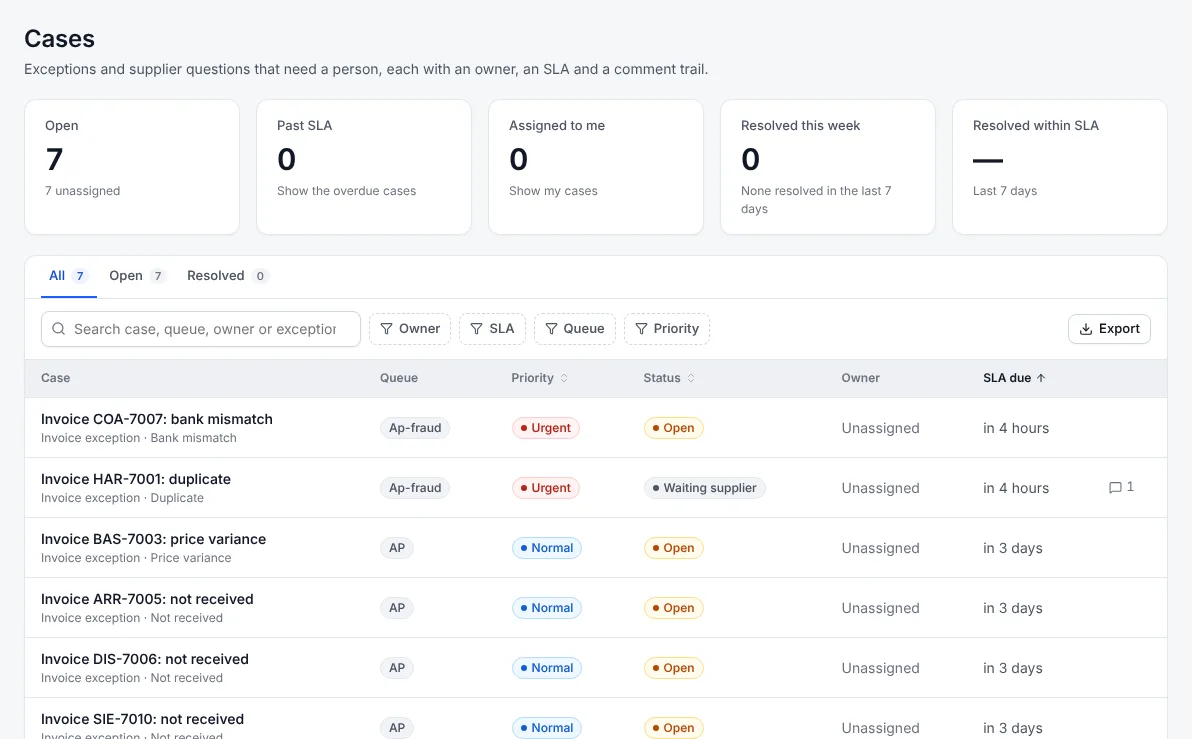
- Cases for every exception, with an owner, an SLA and a supplier conversation.
Try it on your own documents
A bake-off kit measures capture on a labeled sample of your own invoices: field accuracy, straight-through rate and, most important, how many errors would have posted without review. A connector check runs against your ERP and records system sandboxes before go-live.
See it on your own invoices
We run a bake-off on a sample of your real invoices and connect to a sandbox of your ERP, so you can judge the results before you sign anything.